We have come a long way since Disney animators were hand-drawing cells to animate the animal kingdom into awkward--but admittedly very sweet, humorous and playful—narratives.

Perhaps one of the greatest achievements of those early pieces was getting humans to believe in the dialogues animals had with each other.

To some, that anthropocentric way of understanding the animal kingdom is repugnant. Science (which I like and respect) has a way of organizing phenomena into terms that conform to human logic. While there may be patterns in animal behavior, it’s still lofty to believe we know the full potential of their communicative meaning.

But Flow isn’t about trying to understand animal behavior. Instead, it uses animals to draw humans out of the painful realities of their own imperfect existence, and to witness the inherent flaws of society and human behavior at large.


This technique of creating a psychological distance from triggering experiences is used in Sand Tray therapy.

In an office setting, a child (or adult) will choose one or a few objects from a large selection, place them in a sand box that sits in the middle of the therapist’s office, and share stories formed around the figure.

I once chose a lonely, sad, misunderstood, frustrated, sick of the dating scene, and scared, plastic owl. Keep in mind, this two-inch-tall polymer effigy was somewhat poorly rendered.

But boy did it speak for my angst.

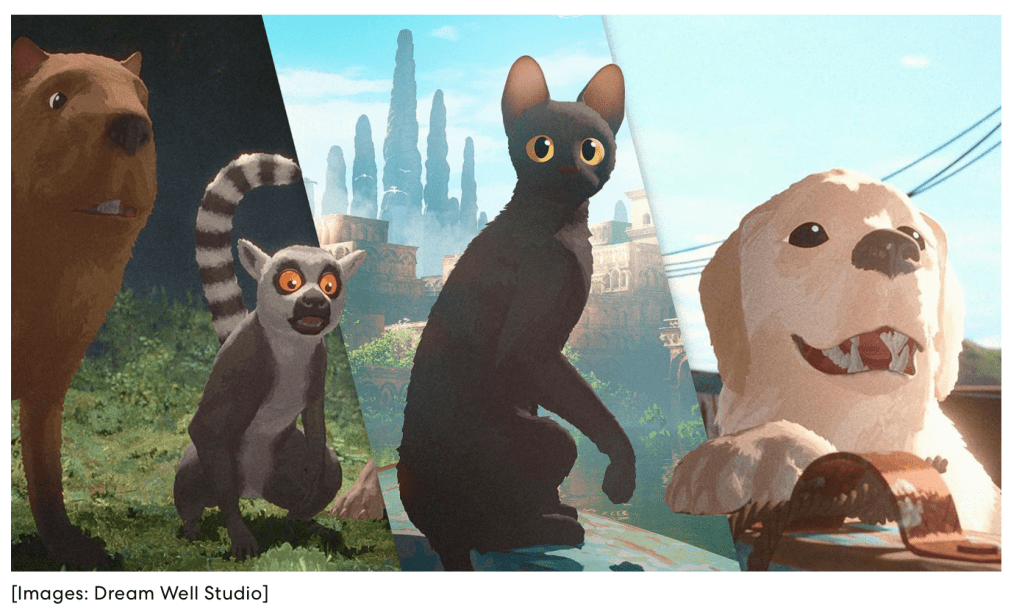
It’s harder to examine the illness of our own social media behavior and collective obsession with consumerism than it is to find a certain sweetness in a lemur’s hoarding tendencies, and their maniacal need to stare into an art-deco-era hand mirror.

There’s an optimal distance created in witnessing these habits projected onto a lovable, (albeit neurotic,) animal form. But the underlying pathology we witness in the movie is clearly a contemporary human problem; one I imagine most lemurs are spared.


We join these creatures in a post-human/post-civilization world.

From the items the lemur collects, it appears the event that evaporated humankind happened sometime in the early to mid-20th Century—when skeleton keys and glass buoys were still used.

By choosing this moment in the past, the filmmakers/writers spare contemporary viewers the guilt of what we are actively doing to our planet. Maybe anything more current would have made would have made it harder to gain the necessary distance to engage with the germane subject of the cross-cultural/cross-political divides these animals must ford?

No less, anything more contemporary would have necessitated the inclusion of even more complicated and horrific renderings of blight to the land.

Speaking of the rendering, that is what sunk this movie.
Image courtesy of Fast Company.com
I felt emotionally hijacked.

As the odyssey draws the viewer into romantic visions of landscapes and the remnants of great civilizations, the narratives of these animals lured me into painful spaces of grief.

Spaces that covered the loss of my dear cat, the death of my father, my mother’s dementia, the destruction of wilderness habitats, the suffering of creatures at the hands of humans… yet the movie’s artistry made me feel I was wasting my resurrected grief.

Early on, I noticed the animals were often pixelated. Other times it felt like the animators just gave up on shading them, in order to push through a vapid action scene built around dazzling colors--like schools of fish being caught by the protagonist cat, or that same cat trying to outrun the flash flood that would drown the entire landscape--which begins the boat journey upon which the central characters embark.


Eventually, the stoic secretary bird, the wary domestic cat, the oafy capybara, the… Labrador retriever and the edgy lemur float upon an ancient city with massive, phallic obelisks rising into the sky.

We assume a vantage point from their perspective, and the camera sweeps from side to side and up into the clouds. The movements reminded me of watching contemporary first-person video games. (The reference was unwelcome.) It was yet another element of artifice that intruded upon my desire to bond with the plight of the animals, and the interpersonal emotional complexities they were navigating.

To be clear, I didn’t think Buzz Lightyear, Woody, or the ants in Antz, were real. I always interacted with them as computer-rendered animations. But they were done well enough, and with care to the precision of movement, body language, light/shadow, so that the medium wasn’t a barrier, and I could relate to their emotional plights.

One of my favorite 33 minutes of animation, Dumbland by David Lynch, was made using his computer, and widely available Flash software. His drawings were crude, and had a naïve aesthetic.

The black-line-stick-figure characters were posited against flat white backgrounds. The sound, the omnipresent rage, and the rendering were all in fluid concert.

At the beginning of Flow, I was laughing with my date about the number of studios and production companies that were advertising their commitment to the film.

I didn’t count, but it was easily more than ten.

Of course, it takes a lot of money to create a film like this: ~$4 million. And my criticisms aren’t about comparing the possibilities of what an American Hollywood budget can achieve versus a Latvian (with some help from French and Belgian sources) production.

Creating art can sometimes be about negotiating compromises to work within a budget and/or the limitations of the medium. I was saddened by where Zibalodis decided to give up, and where he focused his artistic attentions.

(Perhaps less video game, and more shading.)

When the movie was over, I felt frigid.

So much was exposed, but I didn’t have the ability to let it go. Meanwhile, my date was waterworks. We spent a solid ten minutes convalescing, alone, well after everyone else had rushed out of the theater to check their phones.
 Sunshine and Olly
Leave a comment